
_(1).svg?revision=1)

Why KCS Works
Defining knowledge, how it flows, and how the structure of KCS generates learning and keeps knowledge relevant.
The Attributes of Knowledge
Understanding KCS starts with an understanding of what we mean by knowledge. It is helpful to put knowledge in the context of data and information. What distinguishes data from information? Data is just numbers or words, while information is organized numbers or words. The organization of data into information gives it some meaning. What distinguishes knowledge from information? Knowledge is information upon which I can act. Knowledge has action associated with it; we can do something with it.
KCS seeks to capture the collective experience of the organization in ways that others can use. "Use" or "act on" being the key point.
For example: the long-range weather forecast for an office worker in San Francisco is interesting information. That same weather forecast for a vineyard manager in Napa is actionable; the vineyard manager will make decisions and take actions to maximize the yield and quality of his harvest. What is knowledge to some is only information to others.
What are some of the key attributes of knowledge? First, we must recognize that information I can act on is dependent on my having some context or experience with that information. That is, I have to already know some things that complement the information to make it actionable. So information that is actionable to me might not be actionable to you. We all bring something to the knowledge party. This introduces an uncomfortable ambiguity about knowledge. What is knowledge to me might not be knowledge to you. Knowledge is not an absolute! This means that what we have in our "knowledge base" is really only potential knowledge because the usefulness of that information depends on the context, experience, and need of the person looking at it. Information becomes knowledge in the moment of use.
We all have some knowledge: the ability to take action on information. It is interesting to consider a few questions about our own knowledge:
- How did we get the knowledge we have?
- When do we stop learning?
- How confident are we in our knowledge? Are we ever one hundred percent confident in what we "know"?
- How do we gain confidence in what we know?
We gain knowledge through interaction and experience. Most of us would agree that we are never absolutely certain about our knowledge because in fact we never stop learning. We are constantly gaining new perspectives and enhancing what we know. And we gain confidence in what we know by trying it, the same way we gain it initially, through experience. We do not systematically get a subject matter expert to review our knowledge and tell us what is good and what isn't.
When considering the attributes of knowledge we could say knowledge is:
- Gained through interaction and experience
- Constantly changing (we never stop learning)
- Never 100% complete or 100% accurate
- Validated through use, experience and interaction (not by subject matter experts)
Is this what people in our organization expect when we say we are implementing a knowledge base or a knowledge management practice? Do they expect it to be created as a result of interaction and experience, constantly changing, never complete, not absolutely accurate, and validated through use? Usually not! Often, the expectation of a knowledge base or a knowledge management system is that it contains perfect, pristine knowledge approved by experts. We have to shift these expectations if we want to harness the power of our collective knowledge and experience. This means a shift in thinking from:
- individual to team
- activity to value creation
- completion to evolution
- escalation to collaboration
- content to context
- knowing to learning and sharing
Knowledge is a Complex System
This shift in thinking is helped along by a model built by Dave Snowden called the Cynefin framework. It's a decision making framework that identifies different kinds of problems and the best way to approach them. While the model describes five different domains, or types of problems, two are specifically helpful in thinking about our approach to knowledge management.
In the complicated domain, we find situations in which there is a direct relationship between cause and effect; there's a clear understanding of the relationship between the elements in the system. Building an airplane is an example of a complicated problem. It can be managed with a checklist and a group of experts. To influence a system like this, we gather data, analyze and understand that data, and make decisions based on our analysis.
Organizations have a tendency to approach all problems as if they are complicated. It is tempting to think that if we just gather a bit more data, we will be able to analyze our way out of problems. But in some scenarios, the most effective approach is to experiment and observe the outcome before iterating and experimenting again.
In the complex domain, we find situations that are more than the sum of its parts: cause and effect between the elements is not clear. Corporate culture is an example of a complex system. It's hard to have a complete list of all of the influencing factors, and hard to know with any consistency what actions will lead to what outcomes. To influence a complex system, we have to experiment, then observe and gather data, and then run the next experiment to tease out which of the elements impact the others.
Knowledge flows like a complex system: it's hard to know who knows what, in what context, and how to access it. One of the things that makes KCS so powerful is that it gives us an approach for influencing and learning from this complexity.
Double Loops Address Complexity
KCS is a living system, not a project with a completion date. It is based largely on research done in the area of complex adaptive systems, which describes double loop processes, as opposed to linear ones.
Loopy processes can be difficult to introduce, since each step is connected to the others, so let's begin what the whole system looks like, and then we'll see an example of how these loops show up in a workflow.
To optimize the health of the knowledge base and the capability of the organization, the eight Practices of the KCS methodology are organized into double loop processes that reinforce each other. These Solve and Evolve Loop processes are the operational activities that make up the system.
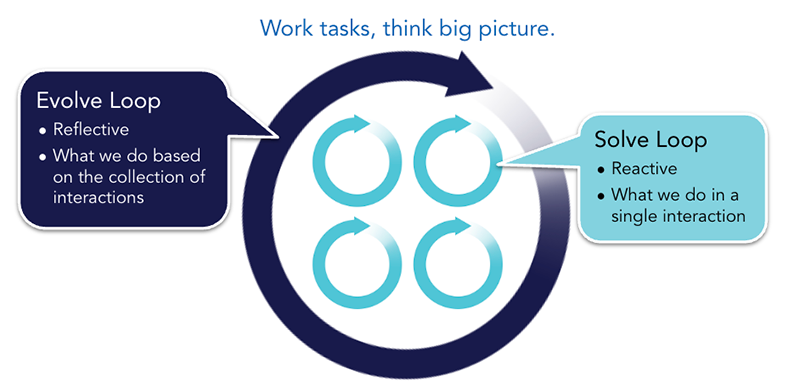
The Solve Loop represents the responsibilities of the responder, or knowledge worker, when they are resolving a requestor's issue. Solve Loop Practices are reactive and transactional.
The Evolve Loop represents the responsibilities of leadership and the organization-level process. Evolve Loop Practices define, learn from, and improve the interactions happening in the Solve Loop.
In the Create Value Principle, we say "Work tasks; think big picture." The "work tasks" is the Solve Loop and the "big picture" is the Evolve Loop. We want to focus on completing tasks in the Solve Loop with an understanding of the potential benefits the collection of tasks provides in the Evolve Loop. The Evolve Loop reflects on and learns from a collection of Solve Loop tasks and associated knowledge articles. It only works if each task is done correctly. The Solve Loop and Evolve Loop are interdependent: each enables the other.
We need to look after interactions and activities if we want to learn from and influence the patterns. The Solve Loop and Evolve Loop together create a system that is self-correcting. It is the aggregate of lots of Solve Loop events, each handled correctly, that enables the Evolve Loop analysis. By analyzing the collection of events and related knowledge articles over time, the Evolve Loop identifies areas for improvement in the Solve Loop. And, perhaps most importantly, the Evolve Loop identifies opportunities for improvement to the business. The root cause analysis done in the Evolve Loop can drive improvements to products, services, processes, and policies that are based on the collective experiences of knowledge workers and of those we serve.

Example Solve Loop Workflow
What might this look like in a support center? A question comes in to a knowledge worker, who reviews the request and captures the requestor's context. The responder searches the knowledge base, using that context. They find a knowledge article that answers the question, link that article to the request, and provide the knowledge to the requestor.
When this Solve Loop flow is followed, it provides usage data to analyze in the Evolve Loop, including insight into the requestor (and responder) experience and enabling corrective action like product, process, or policy improvements.
