
_(1).svg?revision=1)

Skills of a Coach
The role of of a coach is first about understanding people’s doubts and concerns before it is about telling people about the benefits or inviting them to try something different. Sustainable change requires bringing to light the underlying assumptions and beliefs that justify a person’s doubts or misconceptions.
Effective KCS Coaching relies on:
- A thorough understanding of the KCS Practices
- Ability to articulate the why we are doing KCS and what's in it for the knowledge worker
- Demonstrated commitment to the success of team members
- Excellent communication skills, particularly in the following areas:
- Listening skills, seek to understand
- Explaining and describing concepts
- Providing feedback
- Influencing to generate results
- Mindfulness of feelings
- Understanding of support processes and tools
- Demonstrated ability to:
- Manage time effectively
- Ability to identify coaching moments - use data and measures to help others become more proficient
- Appropriate communication with management
- Deal with objections
Dr. Beth Haggett describes five key coaching skills in her KCS Coach Development workshop, a KCS Aligned service. These support the coach competencies required by the International Coaching Federation.
- Listening - to what is said and to what is unsaid. This takes place when the influencer is not talking.
- Inquiry - asking open-ended questions to understand where others are coming from.
- Reflection - making connections, clarifying assumptions and beliefs.
- Appreciation - recognizing (out loud) the strengths and contribution of others.
- Advocacy - we can advocate for people or ideas; often this is where we advocate for a different point of view. Using the four previous skills builds trust and creates an opportunity for us to offer new ideas and perspectives as part of a conversation (not as a way to point out the ways in which the coachee is wrong).
Identifying Underlying Beliefs
If we want to change someone's mind, we first have to understand what they believe. Doubts, misconceptions and objections are gifts badly wrapped; they give us insight into an individual’s point of view: their beliefs, what they understand, and more importantly, what they don’t understand.
Understanding or exposing the belief(s) that lead a doubter to have their doubt creates an opportunity to offer a different point of view. Beliefs are often not recognized or stated explicitly by the doubter. The goal is to identify the underlying belief(s).
A change in beliefs is required to create a change in results. One way to think about this is represented by the BABR model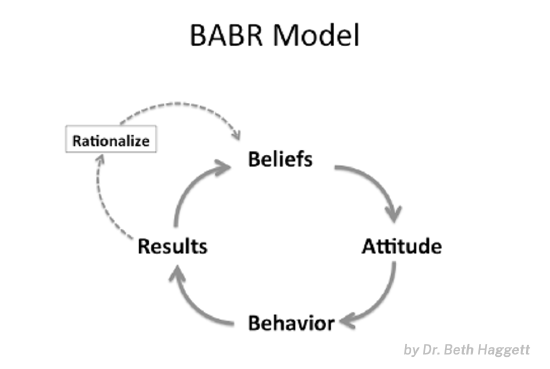 :
:
- Beliefs influence Attitude,
- Attitude influences Behaviors, and
- Behaviors drive Results.
To change the results, we have to understand the beliefs and offer a different way to think about things. Using influence skills is an effective way to expose the underlying belief(s). [The BABR model and the influence skills are from Dr Beth Haggett’s KCS Coach Development workshop and materials.]
Exposing underlying beliefs is critical in helping doubters think about things differently. We don’t change minds with one conversation. It is an iterative process, and a great opportunity to practice seeking to understand before seeking to solve.
Suggestions for Discovery
“Change that is imposed will be opposed.” - Spencer Johnson
It takes curiosity, patience, and practice to expose underlying beliefs. Here are some ways to approach conversations in which there is resistance.
- Seek to understand before you seek to solve: “Tell me more about that”
- Meet them where they are with empathy: understanding a person's point of view is not the same as agreeing with it. Be curious about why a doubter feels the way they do.
- Recognize emotion-based versus logic-based objections. Most doubts or objections come from an emotional basis (fear, uncertainty, lack of trust). We cannot use logic to diffuse emotion or change a person’s point of view. We must diffuse the emotion before we can use logic.
- It is far more effective to invite people to join a change initiative than to impose it upon them. Generally we feel more positive about the things we choose to do rather than the things we are told we have to do. If we can offer people a different perspective and help them understand why we want to do things in a different way as well as the benefit for them, we can then invite them to try a different approach.
- And always…..Ask before coaching.
- "Is now a good time?"
- "Can I share something that has worked for me?"